Window screens take more abuse than almost anything else on the outside of a house. Sun, wind, pets, kids, pressure from a hose, and being pulled in and out for cleaning all add up. When one finally tears or bends, the question is whether it can be fixed or needs to be replaced.
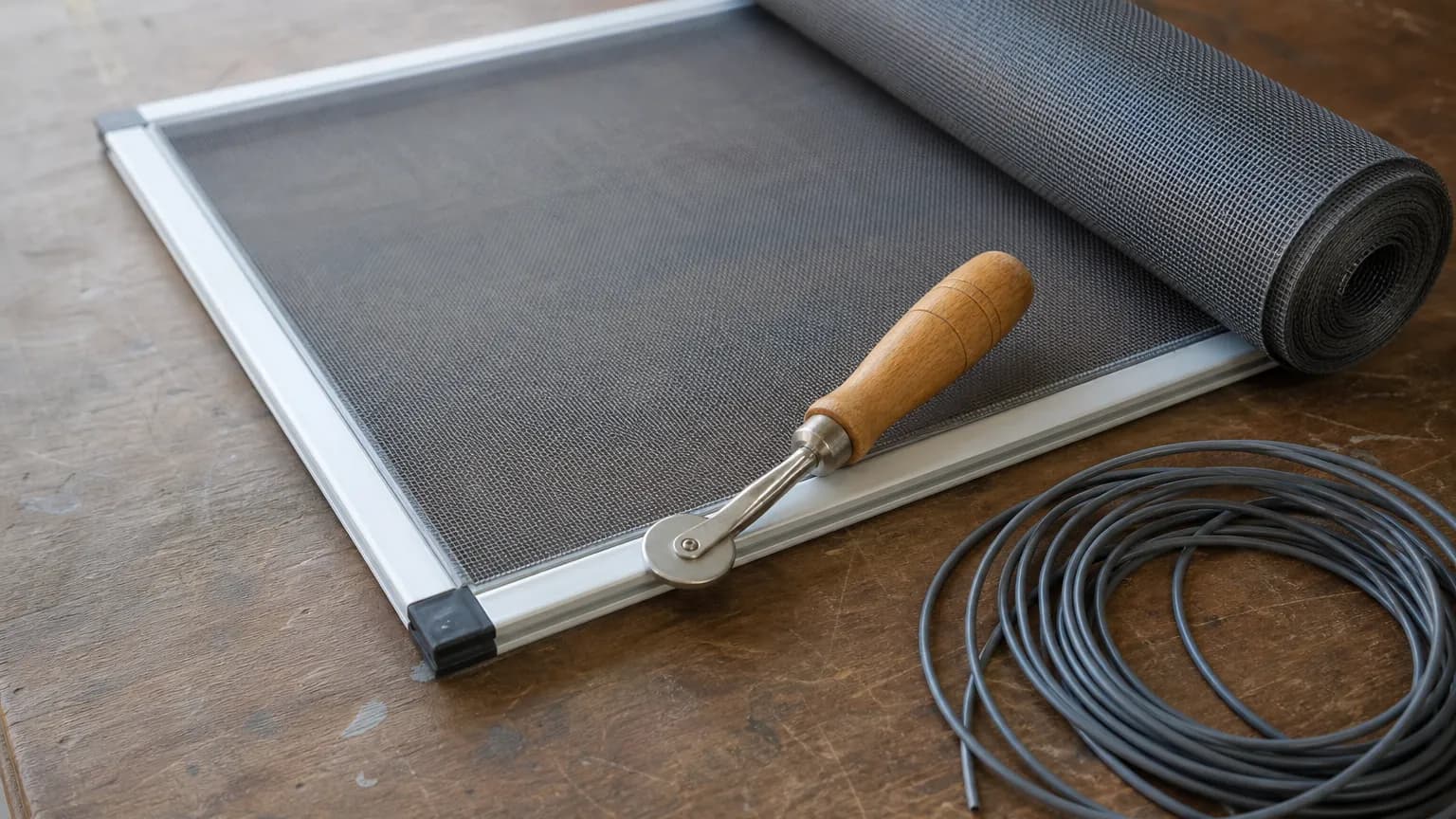
Most of the time the answer is somewhere in between. A screen has three parts: the frame, the mesh, and the spline that holds the mesh in a groove around the frame. Each part fails in its own way, and you only need to replace the part that failed.
Start with a quick inspection
Take the screen out and lay it flat, or look closely from inside with good light behind it. Check four things.
Tears and holes
Look for punctures, slits and places where the mesh has pulled apart. Note the size and the location. A pinhole in a corner is a different problem from a long tear across the middle. Holes of any size let insects in, so none of them should be ignored for long.
Bent or damaged frames
Sight down each side of the frame like you would a piece of lumber. Frames bend when they are forced into the window, stepped on or leaned against. Check the corners too. Most frames are joined with small corner inserts, and those crack. Look at the hardware: the pull tabs, springs and clips that hold the screen in the window.
Loose spline
Run a finger along the groove. The spline should sit snug and even all the way around. If it is popping out, cracked, or hard and shrunken, the mesh will go slack, ripple in the wind and eventually pull free at a corner.
Sun-brittle mesh
This one is common in Southern California. Years of strong sun break down screen mesh. It fades to a chalky gray, feels stiff, and tears when pressed lightly with a fingertip. Brittle mesh cannot be patched, because the material around the patch fails next. If one sun-facing screen is brittle, the others on that side of the house are usually close behind.
Repair, rescreen or replace
| What you find | Best fix | Why |
|---|---|---|
| Pinhole or short tear, mesh otherwise healthy | Patch, or rescreen if appearance matters | The mesh still has life. A patch works but stays visible |
| Long tear, several holes, pet damage | Rescreen | New mesh in the same frame costs less than a new screen and looks new |
| Faded, stiff, brittle mesh | Rescreen | The material has reached the end of its life. Patches will not hold |
| Loose, cracked or shrunken spline | New spline, usually with new mesh | Old mesh rarely tensions well a second time |
| Slightly bowed frame, corners intact | Straighten and rescreen | Minor bends can often be corrected |
| Kinked or creased frame, broken corners | Replace the whole screen | A kinked frame will not sit flat or seal against the window |
| Missing screen | Replace | A new frame is built to the window's measurements |
| Broken tabs, springs or clips | Replace the hardware | Small parts are usually replaceable without a new screen |
The general rule: if the frame is straight and the corners are solid, keep the frame and replace the mesh. If the frame is kinked or the corners are broken, replace the whole thing. A screen that does not sit flat in the window leaves gaps, and gaps defeat the purpose.
Mesh types in general terms
When a screen is being rescreened or rebuilt, you get to choose the mesh. There are three common families.
Standard fiberglass
This is what most homes have. It is flexible, does not crease or dent, offers good visibility and airflow, and comes in gray and charcoal. Charcoal tends to be easier to see through from inside. It is the sensible default for most windows.
Pet-resistant
Made from a much thicker, coated yarn, this mesh is built to survive claws, paws and a dog that leans on the patio door. It is noticeably tougher than standard mesh. The trade-off is a slightly heavier look and a little less visibility and airflow. Many households use it on sliding screen doors and the low windows pets can reach, and keep standard mesh everywhere else.
Solar
Solar mesh has a denser weave designed to block a share of the sun's heat and glare before it reaches the glass. It can make sun-facing rooms more comfortable, reduce fading on floors and furniture, and add daytime privacy. It darkens the view somewhat, so it is usually chosen for south and west windows, not the whole house.
There are other specialty meshes, including finer weaves for very small insects and high-visibility options. For most homes, a mix of the three above covers every window.
Measuring a screen
If you are ordering a replacement or describing one over the phone, accurate measurements matter. A screen that is off by a small amount either will not go in or will not stay in.
- If you have the old screen, measure the frame itself, outside edge to outside edge, for width and height. Measure to the nearest sixteenth of an inch. Then note the thickness of the frame and the type and position of the hardware: pull tabs, springs, plungers or clips, and which sides they are on.
- If the screen is missing, measure the channel or opening the screen sits in, and look at how the neighboring screens are held in place. The way the screen installs, such as springs on top or on one side, affects the finished size, so the frame is built slightly smaller than the opening.
- Measure every window. Windows that look identical are often a little different, especially in older homes.
- Note the frame color so new screens match the old ones.
- Label each screen with its window as you remove it. It saves a lot of guessing later.
Sliding screen doors are their own category. They have rollers, a handle and a latch, and they are measured and adjusted differently from window screens. Rollers that drag or jump the track can often be replaced or adjusted without replacing the door.
Why it is worth doing
A torn screen lets in insects, and a sagging or missing one makes an otherwise tidy home look neglected. Screens in good shape also let you open the windows on a mild evening instead of running the air conditioning.
Screens affect your glass too. A dusty screen sheds dirty water onto the window every time sprinklers or a hose hit it, which adds to the mineral buildup described in our post on hard water spots on windows. Cleaning or rescreening at the same time the windows are cleaned is efficient, because the screens are already out.
How we handle screens
ALLCLEAN Home Services provides screen repair and replacement for windows and doors, for homes and businesses across Riverside County and Orange County. We look at each screen, tell you which ones need new mesh and which need a new frame, and go over mesh options for the rooms where pets or afternoon sun are a factor. Details are on our screen repair page.
If you have screens that are torn, brittle, bent or missing, book a free estimate online and we will sort out which ones can be saved.