Every year the same routine plays out. The bins come down from the garage rafters, half a strand does not light, someone goes up a ladder to the second-story eave, and a few weeks later it all happens again in reverse. Permanent outdoor lighting exists to end that cycle. The lights are installed once along the roofline, they stay up all year, and you change what they do from your phone.
It is not the right choice for every home, so here is a fair comparison.
What permanent outdoor lighting is
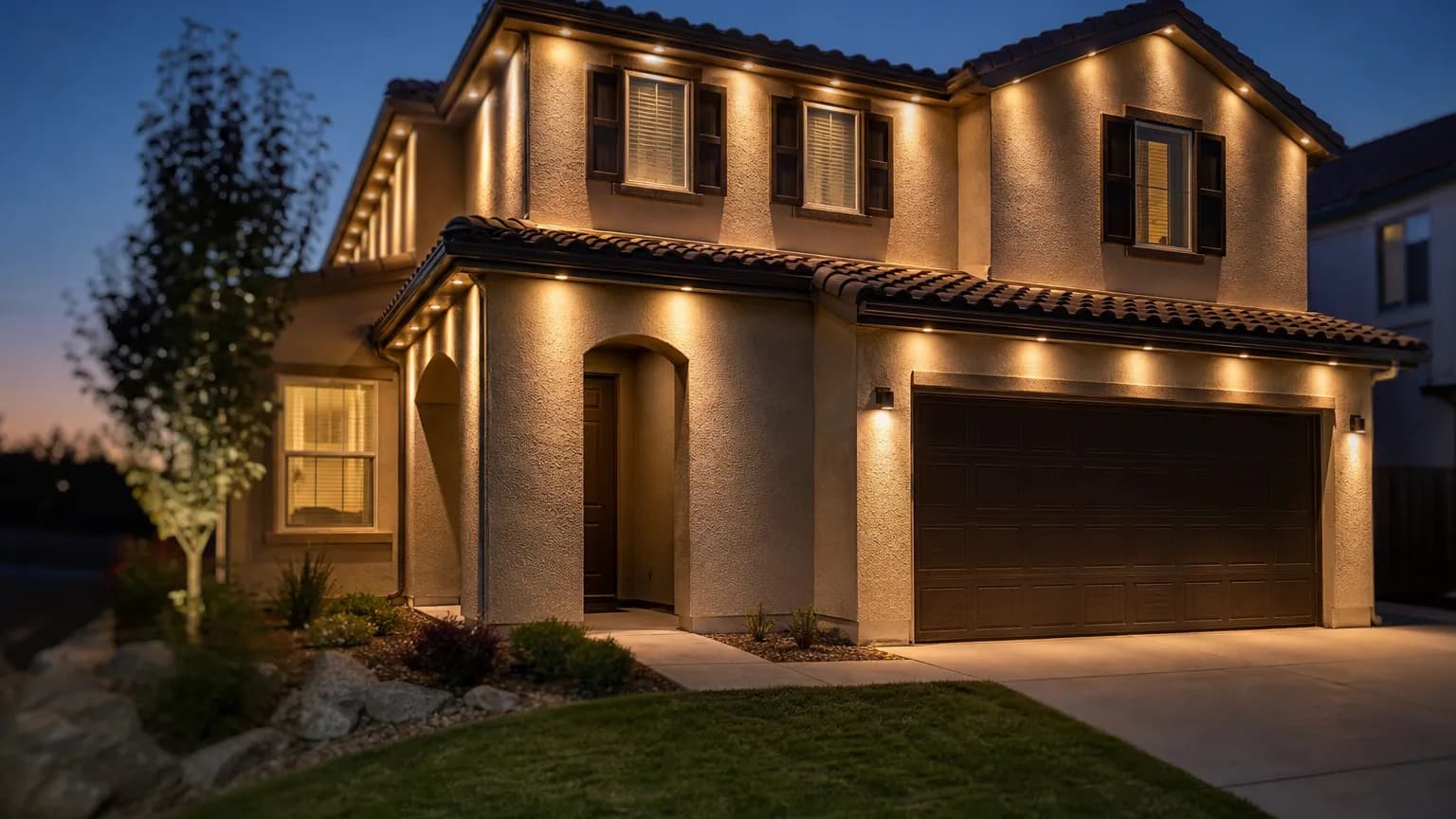
A permanent system is a run of small, weather-rated LED lights mounted along the roofline, usually under the eaves or along the fascia. The lights sit in a slim track or channel that matches the trim color, so the hardware blends in during the day. Each light can be set to a wide range of colors, including warm and cool white, and the whole system is operated from an app.
Temporary lights are the familiar strands: clipped to gutters and shingles for the season, plugged into an outdoor outlet, and taken down afterward.
Side by side
| Permanent LED roofline lighting | Temporary string lights | |
|---|---|---|
| Setup | Installed once | Hung and removed every season |
| Ladder work | Done during installation | Repeated every year |
| Look in daylight | Low profile track matched to the trim | Visible wires, clips and cords |
| Colors and effects | Changeable any time from an app | Fixed by the strand you bought |
| Use through the year | Holidays, events and everyday accent lighting | Usually one season |
| Storage | None | Bins, tangles and damaged strands |
| Upfront cost | Higher | Lower |
| Ongoing effort | Low | Labor every year, plus replacing strands |
| Flexibility of layout | Fixed to where the track is installed | Can be rearranged each year |
Temporary lights win on upfront cost and on the freedom to do something different each year. Permanent lights win on nearly everything else, especially for two-story homes where hanging strands means real time on a tall ladder.
How app control works in general terms
The details vary by system, but the basics are consistent.
- A controller is mounted somewhere out of the way, often in the garage or near an exterior outlet. It powers the lights and tells each one what to do.
- The controller connects to your home Wi-Fi. Some systems also use Bluetooth for setup or as a backup. A reliable signal where the controller sits matters, so that is checked during planning.
- The app is the remote. You choose a solid color, a pattern or a saved scene. Because the lights are individually addressable, you can do things like alternate two colors, light every third bulb, or run a slow fade.
- Schedules automate it. Most apps let you set on and off times, often tied to sunset, and assign different scenes to different dates. Set it once and the house handles itself.
- Zones are common. The front roofline, a side gable and a patio can often be controlled separately.
- Brightness is adjustable, which matters for everyday use and for being a good neighbor.
You do not need to be technical. If you can set an alarm on your phone, you can run the lights.
More than holiday lights
This is the part people underestimate before they own a system. Holiday displays are a few weeks of the year. The rest of the time, the same lights work as architectural lighting.
Everyday accent lighting. A soft warm white along the eaves washes light down the walls and makes a home look finished at night. It also lights walkways, side yards and entries that are otherwise dark, which makes coming home after dark more comfortable.
Holidays all year. Winter holidays are the obvious one, but the same system handles orange and purple in the fall, red, white and blue in the summer, and pastels in the spring, without touching a ladder.
Events and occasions. Team colors on game day, school colors for a graduation, a birthday, a backyard party, an awareness month. Changing the look takes seconds.
Businesses. Storefronts and offices use permanent lighting for brand colors, seasonal displays and better visibility after dark.
What installation involves
A good installation is mostly planning. Here is the usual sequence.
- Walk the property. Decide which rooflines, gables, peaks and eaves get lights. Front-facing lines matter most. Some homeowners include the back patio for entertaining.
- Measure and design. The total length determines materials, where power is injected along the run so brightness stays even, and where the controller goes.
- Choose the track color. The channel is matched to the fascia or soffit so it disappears during the day.
- Mount the track and lights. Track is cut to follow the roofline, corners and peaks are mitered, and the lights are seated at even spacing. Wiring is routed out of sight.
- Connect power and the controller. The system typically runs on low voltage from a power supply plugged into a protected outlet.
- Set up the app. The system is connected to Wi-Fi, zones are named, and a few scenes and a schedule are saved so it is useful from the first night.
Most of the work happens at the eaves, on ladders. That is a large part of why people hire it out: it is a one-time job, and it replaces a yearly one.
One practical tip: a fresh, clean exterior shows lighting at its best. Dusty eaves, cobwebs and stained stucco are much more noticeable under a wash of light. Our seasonal exterior cleaning checklist covers what to clean before the holidays.
HOA considerations
Many neighborhoods in Riverside County and Orange County have homeowner associations, and rules differ a lot from one to the next. Check before you commit.
- Approval. Some associations treat permanent lighting as an exterior modification that requires an application to the architectural committee. Get approval in writing.
- Color rules. It is common for associations to allow colored displays only during a set holiday window and to expect white or no lighting the rest of the year. App control makes that easy to follow, since you can run warm white most nights.
- Hours. There may be quiet hours for decorative lighting. A schedule in the app handles this automatically.
- Appearance. A low profile track in a matching color is the easiest type of installation to get approved, because there is little to see in daylight.
- Neighbors. Even without an association, keep brightness reasonable and aim for a wash of light on your own walls, not a glare into the house next door.
Which one is right for you
Temporary lights still make sense if you decorate lightly, live in a single-story home with easy eaves, rent your home, or enjoy putting up a different display each year.
Permanent lighting makes sense if you decorate every year, dislike the ladder work, have a two-story roofline, want accent and security lighting all year, or host often. The upfront cost is higher, and the payoff is that the yearly labor disappears.
ALLCLEAN Home Services installs permanent outdoor LED lighting that can be customized for holidays, special occasions and everyday use, controlled from your phone. You can read more on our permanent outdoor lighting page. To see what it would look like on your home, book a free estimate and we will walk the roofline with you.